

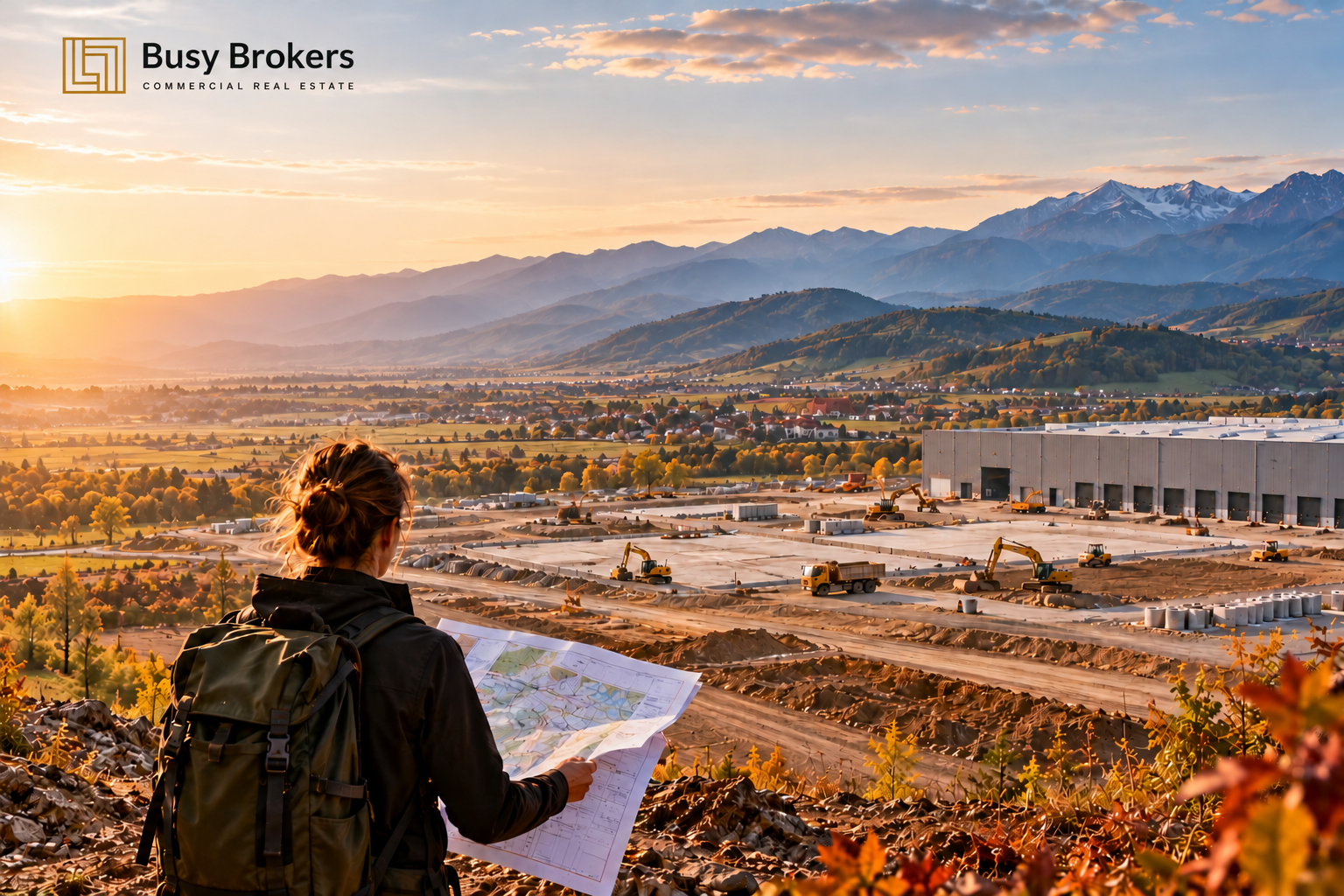
What Makes an Industrial Site Actually Buildable?
Why available land and development-ready land are two very different things.
Industrial land can look like a straightforward investment. A generous plot, an attractive price, a good location and perhaps even a motorway nearby. On paper, everything seems to fit.
But there is a significant difference between land that is available for sale and land that is actually ready for industrial development.
Across Romania, and particularly in developing industrial areas of Transylvania, this distinction can determine whether an investment moves forward efficiently or becomes a costly exercise in permits, infrastructure and unexpected limitations.
So, what really makes an industrial site buildable?
1. Zoning: What Can You Actually Build There?
The first question is not how much land is available, but what the land can legally accommodate.
A plot advertised as suitable for industrial development does not automatically have the necessary urban planning status. In Romania, the distinction between intravilan and extravilan land is important, but being within the built-up area does not, by itself, guarantee permission for industrial construction.
Local urban planning regulations, including the General Urban Plan (PUG), applicable Zonal Urban Plans (PUZ) and detailed planning requirements, determine which activities are permitted and under what conditions.
Building height, land coverage, setbacks, access requirements and permitted industrial activities can all be restricted.
Before making an investment decision, obtaining a current urban planning certificate (certificat de urbanism) is an essential step. It identifies the applicable planning conditions and the approvals required for the proposed development, although it does not itself authorize construction.
2. Utilities: Available Nearby Doesn't Mean Available on Site
Electricity, water, wastewater management, gas and telecommunications are fundamental to most industrial operations.
However, there is an important difference between utilities existing in the general area and having sufficient capacity available for a specific development.
An electricity line passing near a property does not guarantee that the grid can support a manufacturing facility. A water connection may be suitable for a small warehouse but insufficient for an industrial process requiring substantial consumption.
Extending networks, increasing capacity or building dedicated infrastructure can introduce significant additional costs and delays.
For investors, the right question is not simply whether utilities exist, but whether they can support the intended operation, at what cost and within what timeframe.
3. Road Access: A Connection That Works in Practice
A plot located near a motorway or national road may appear attractive, but proximity is not the same as accessibility.
Industrial developments need practical, legally secured access suitable for the vehicles they expect to accommodate.
Road width, turning radii, junction design, weight restrictions and the possibility of obtaining access approvals all influence a site's suitability.
A production facility expecting regular heavy-goods traffic has very different requirements from a small storage operation.
In some cases, improving road access may require additional land, infrastructure works or approvals from road authorities.
A good industrial location is not simply one that appears connected on a map. It is one where the connection actually works.
4. The Ground Beneath the Investment
Not every flat-looking plot is easy to build on.
Soil conditions, groundwater levels, slope, drainage and flood exposure can significantly influence construction feasibility and costs.
A site may require extensive earthworks, ground stabilization, drainage systems or more expensive foundations than initially anticipated.
Former industrial land may also require environmental investigations, particularly where previous activities could have resulted in contamination.
Geotechnical studies, topographical surveys and relevant environmental assessments are therefore more than administrative formalities. They help establish whether a project is technically feasible and what it may cost to develop.
In industrial real estate, what lies beneath the surface can be just as important as what surrounds it.
5. Permits, Restrictions and the Time Factor
Even when a site meets the technical requirements, development still depends on the necessary approvals.
Depending on the project, these may involve environmental authorities, utility providers, road administrators, fire safety authorities and other institutions.
Protected areas, infrastructure corridors, neighbouring land uses or existing easements may impose additional restrictions.
Ownership documentation and cadastral records also deserve careful examination. Unresolved boundaries, rights of way or legal encumbrances can complicate development.
Each requirement adds another element to the project timeline.
For businesses planning production expansion or relocation, delays can translate into real commercial costs. A plot that is cheaper to purchase but takes considerably longer to develop may not represent the best investment.
6. Workforce and Business Infrastructure
A site can be legally and technically buildable without being commercially suitable.
Industrial operations depend on people, suppliers, transport services and access to markets.
A remote location with affordable land may become less attractive when employee commuting, recruitment difficulties or logistics expenses are considered.
This is particularly relevant in Transylvania, where industrial development is distributed across established manufacturing centres, smaller towns and emerging industrial areas.
Locations around Sibiu, Brașov, Alba, Mureș and Cluj each offer different combinations of infrastructure, workforce availability and development potential.
Understanding these differences is essential when evaluating whether a location can support a business over the long term.
7. The Real Question: What Will It Cost to Make the Site Operational?
The advertised price per square metre is only one part of an industrial land investment.
A realistic assessment should consider the full development process: planning, approvals, utility connections, site preparation, access infrastructure, construction requirements and the time needed to complete them.
Two plots with similar surface areas can have dramatically different development costs.
One may already benefit from appropriate zoning, nearby utility capacity and established industrial access. Another may require substantial investment before construction can even begin.
The second plot might still represent an opportunity, but only if the additional costs, risks and timeline are properly understood.
Buildability Is About More Than Permission to Build
Industrial land should not be evaluated only by its location, surface area or asking price.
A truly buildable site brings together legal feasibility, technical conditions, infrastructure capacity and commercial practicality.
For investors and companies expanding in Romania, understanding these factors early can prevent expensive surprises and support better decisions.
At Busy Brokers, we believe that identifying the right industrial property starts with asking the right questions.
Because the most attractive plot is not necessarily the one with the lowest price or the best view.
It is the one that can realistically support the business you intend to build.
Busy Brokers — Connecting businesses with opportunities in Transylvania.