

The Space Between Businesses: Why Industrial Clusters Matter More Than Ever
In industrial real estate, the value of a location is increasingly determined by the businesses, infrastructure and opportunities surrounding it.
When companies search for industrial property, the conversation usually begins with familiar questions. How much space is available? What is the price per square metre? Are utilities connected? How far is the nearest motorway?
These are essential considerations. But there is another factor that can significantly influence the long-term success of an industrial investment: the businesses operating nearby.
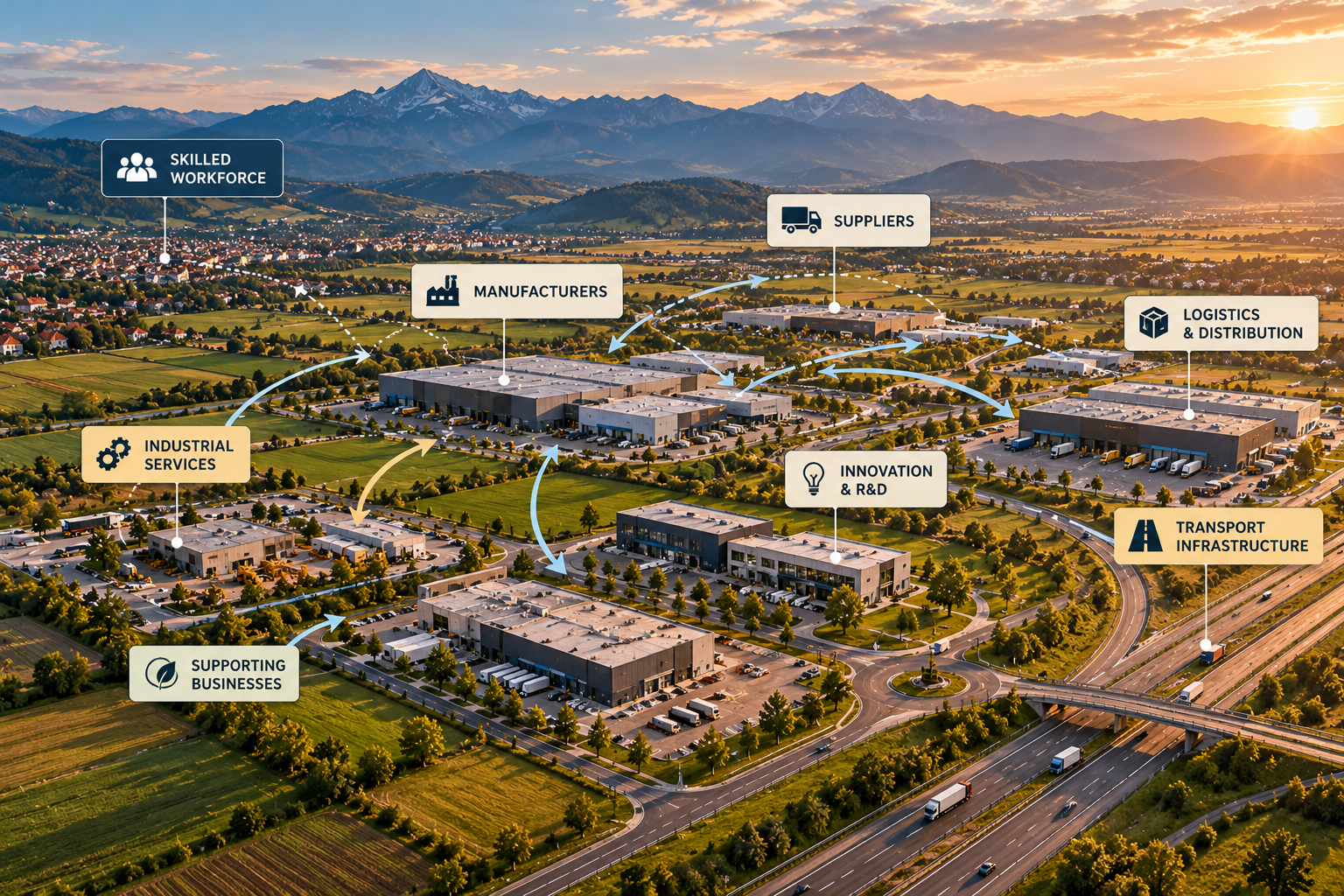
A factory, warehouse or production facility does not exist in isolation. It operates within a network of suppliers, customers, service providers, employees and infrastructure.
And sometimes, the most valuable part of an industrial property is not what stands on the land itself, but what exists around it.
Why Industrial Clusters Matter
An industrial cluster is a geographical concentration of businesses, suppliers, service providers and supporting institutions connected through a particular industry or related economic activities.
These clusters often develop gradually. One major manufacturer establishes a facility, suppliers follow, logistics operators expand their services, and smaller businesses emerge to support the growing industrial activity.
Over time, an entire business ecosystem takes shape.
The benefits extend beyond convenience. Companies operating within established industrial clusters may gain easier access to specialised services, experienced employees, transport infrastructure and potential business partners.
For industrial property investors, this concentration of economic activity can also support sustained demand for production facilities, warehouses and commercial space.
The result is a location whose attractiveness is influenced not only by its physical characteristics, but also by the economic relationships surrounding it.
Proximity Can Become a Competitive Advantage
In manufacturing and logistics, distance translates into time, cost and operational complexity.
A supplier located 15 kilometres away offers different possibilities from one located 150 kilometres away. Deliveries may be organised more frequently, transport requirements may be easier to coordinate, and unexpected production needs can sometimes be addressed more quickly.
This is particularly relevant for industries where production depends on multiple specialised components, technical services or tightly coordinated supply chains.
Being close to other businesses can reduce certain logistical challenges and make operations more flexible.
But proximity is not only about suppliers.
Access to equipment maintenance, packaging services, transport operators, industrial cleaning, engineering expertise and other specialised activities can also influence the efficiency of an industrial operation.
A well-developed industrial cluster provides more than neighbouring buildings. It creates opportunities for businesses to work together.
Transylvania's Industrial Geography Tells an Interesting Story
Transylvania offers several examples of how industrial activity becomes concentrated around established economic centres and transport corridors.
Sibiu and its surrounding industrial areas have developed around manufacturing, automotive-related activities, logistics and supporting services.
Brașov combines an established industrial tradition with manufacturing, engineering and distribution activities, while the wider Cluj area benefits from a diversified economic environment that includes technology, production and logistics.
Alba County, particularly around Sebeș and Alba Iulia, has attracted significant industrial activity, supported by its position along important transport routes.
Mureș and Hunedoara also offer established industrial capabilities, alongside opportunities for the adaptation and redevelopment of existing industrial properties.
These areas are not identical, and their advantages depend on the requirements of each business.
What they demonstrate, however, is that industrial development rarely happens entirely at random.
Businesses tend to concentrate where infrastructure, workforce availability, investment and economic relationships reinforce one another.
For investors exploring industrial real estate in Transylvania, understanding these regional connections can be just as important as evaluating an individual property.
The Workforce Is Part of the Cluster
One of the less visible advantages of industrial clusters is the concentration of professional experience.
When several companies from related industries operate in the same region, the local labour market may develop specialised skills over time.
Technical schools, universities and training providers can respond to regional industry needs. Employees gain experience with particular technologies, production processes and operational standards.
This creates an environment in which businesses may find it easier to recruit people with relevant knowledge.
Of course, concentration also creates competition for employees. A successful industrial area does not automatically guarantee workforce availability, particularly when multiple companies are expanding simultaneously.
Nevertheless, the existence of an established skills base can represent an important advantage compared with developing an operation in a location without relevant industrial experience.
For companies planning long-term investments, understanding the regional workforce is therefore an essential part of evaluating an industrial cluster.
Infrastructure Attracts Businesses. Businesses Attract Infrastructure.
Industrial clusters and infrastructure often develop in a mutually reinforcing relationship.
Good road connections, reliable utilities and accessible industrial land attract investment. As industrial activity increases, demand grows for additional transport capacity, energy infrastructure, telecommunications and supporting services.
This can encourage further development, although improvements are never automatic or guaranteed.
An established industrial area may already benefit from infrastructure that would be expensive or time-consuming to develop independently.
For businesses, this can reduce uncertainty and simplify certain aspects of establishing operations.
For property investors, it highlights an important distinction between a plot of land that is merely available and one that is positioned within an economically active environment.
Two properties with similar dimensions and technical characteristics may have very different long-term prospects because of the infrastructure and business activity surrounding them.
Can Industrial Clusters Become Too Successful?
Clustering also comes with challenges.
As demand for industrial space increases, land prices and rental expectations may rise. Competition for qualified employees can become more intense, and transport infrastructure may face additional pressure.
Established industrial areas can also encounter limitations when available development land becomes scarce.
These challenges create opportunities for neighbouring locations.
Smaller towns and emerging industrial corridors may attract businesses looking for more affordable space while maintaining access to established regional networks.
For investors, this makes it important to look beyond the boundaries of existing industrial parks.
The next attractive location may not be inside the most established cluster, but within reasonable reach of it.
However, potential should be evaluated carefully. Proximity to a successful industrial area does not automatically guarantee that a neighbouring property will benefit from the same infrastructure, workforce or market demand.
The Opportunities Between Established Industrial Centres
Industrial development is often discussed through individual cities: Sibiu, Brașov, Cluj-Napoca, Alba Iulia or Târgu Mureș.
But some of the most interesting opportunities may lie along the connections between them.
Transport corridors, smaller industrial towns and areas with available land can offer alternatives for businesses that need access to several regional markets.
A company may not need to be located directly inside a major industrial centre to benefit from its economic activity.
For certain operations, a well-connected location between established business hubs may provide a more suitable balance between accessibility, cost and room for expansion.
This is where understanding regional industrial geography becomes particularly valuable.
Rather than evaluating properties as isolated points on a map, investors can examine how those points connect to wider networks of production, logistics, labour and services.
The Future of Industrial Real Estate Is Connected
Industrial property has traditionally been evaluated through tangible characteristics: land area, building specifications, utilities, access and price.
These fundamentals remain essential.
But as businesses seek more efficient supply chains, operational flexibility and opportunities for growth, the surrounding economic environment deserves equal attention.
Industrial clusters illustrate an important principle: businesses can create value for one another simply by being connected through geography, infrastructure and economic activity.
For investors and companies exploring opportunities in Transylvania, this means looking beyond the boundaries of a property.
Who operates nearby? Which industries are growing in the region? What services are available? How easily can the location connect to suppliers, employees and customers? And what opportunities might emerge as the surrounding business environment develops?
Because in industrial real estate, the value of a location is not always defined by the space a business occupies.
Sometimes, it is defined by the space between businesses.
Busy Brokers — Connecting businesses with opportunities in Transylvania.