

The Industrial Property Nobody Wants. Yet.
Why overlooked factories, ageing warehouses and forgotten industrial sites may hold more potential than meets the eye.
Some industrial properties attract attention immediately. Modern warehouses near motorways, newly developed industrial parks and production facilities equipped with the latest infrastructure tend to appear at the top of investors' lists.
Others remain on the market for months, sometimes years.
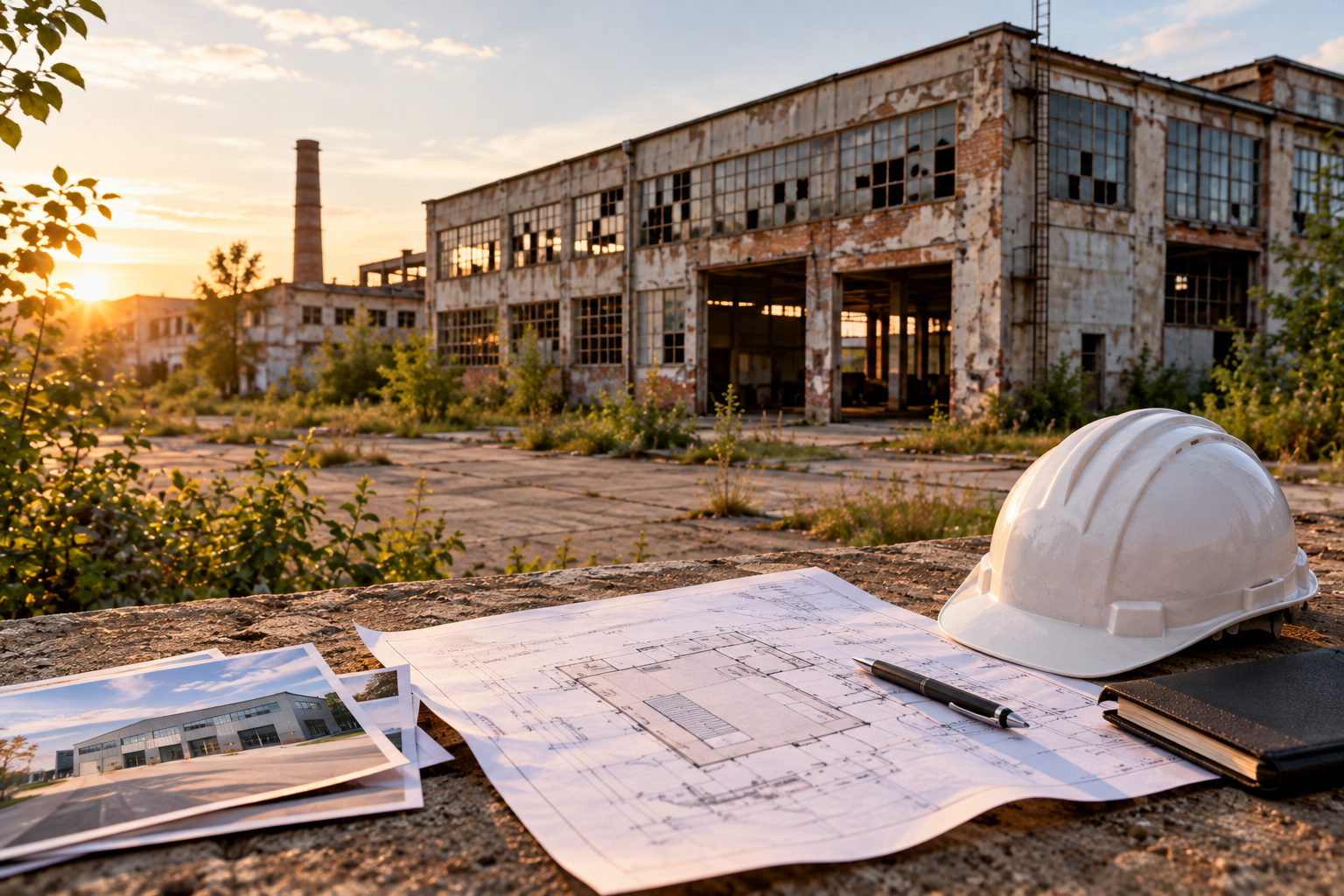
An old factory on the outskirts of a small town. A warehouse that hasn't been modernized in decades. A former production site with overgrown surroundings and buildings showing visible signs of neglect.
At first glance, these properties may seem like yesterday's industrial real estate.
But appearances can be misleading.
Across Transylvania, decades of manufacturing activity have left behind industrial buildings and sites that no longer serve their original purpose. Some have become obsolete. Others have simply been left behind as businesses closed, relocated or changed their production methods.
For investors willing to look beyond the obvious, these properties deserve a closer examination.
Why Do Some Industrial Properties Get Left Behind?
Not every vacant industrial building is the result of a poor location or an unsuitable property.
Sometimes, the business occupying it simply disappeared.
A factory may have closed because its products were no longer competitive. A family-owned manufacturing business may have ended operations without a successor. A larger company may have consolidated production into another facility.
The property remains, even when the original economic activity does not.
Other buildings struggle to attract buyers because they no longer meet contemporary industrial requirements.
Low ceilings, outdated electrical installations, inefficient layouts, insufficient loading areas or deteriorating structures can make them less appealing than modern alternatives.
And sometimes, the biggest obstacle is perception.
A neglected building surrounded by weeds rarely creates the same first impression as a newly constructed industrial hall.
Yet the condition of a building and the potential of a property are not necessarily the same thing.
The Value of What Is Already There
Developing a new industrial facility involves more than purchasing land and constructing a building.
Road access must be established, utilities connected, permits obtained and infrastructure developed.
Existing industrial properties may already offer some of these advantages.
A former factory might have an established electricity connection, access roads suitable for heavy vehicles, water infrastructure or land that has historically been used for industrial activities.
Depending on the property, these features could represent significant advantages compared with starting from an undeveloped plot.
However, their existence does not automatically guarantee that they are usable today.
Electrical capacity may be insufficient, connections may require modernization, and previous industrial use does not necessarily mean that a new activity will be authorized.
The opportunity lies in identifying which existing assets retain practical value and what it would cost to bring them back into operation.
Sometimes, the most valuable part of an old industrial property is not the building itself, but the infrastructure and location surrounding it.
Renovation, Conversion or Demolition?
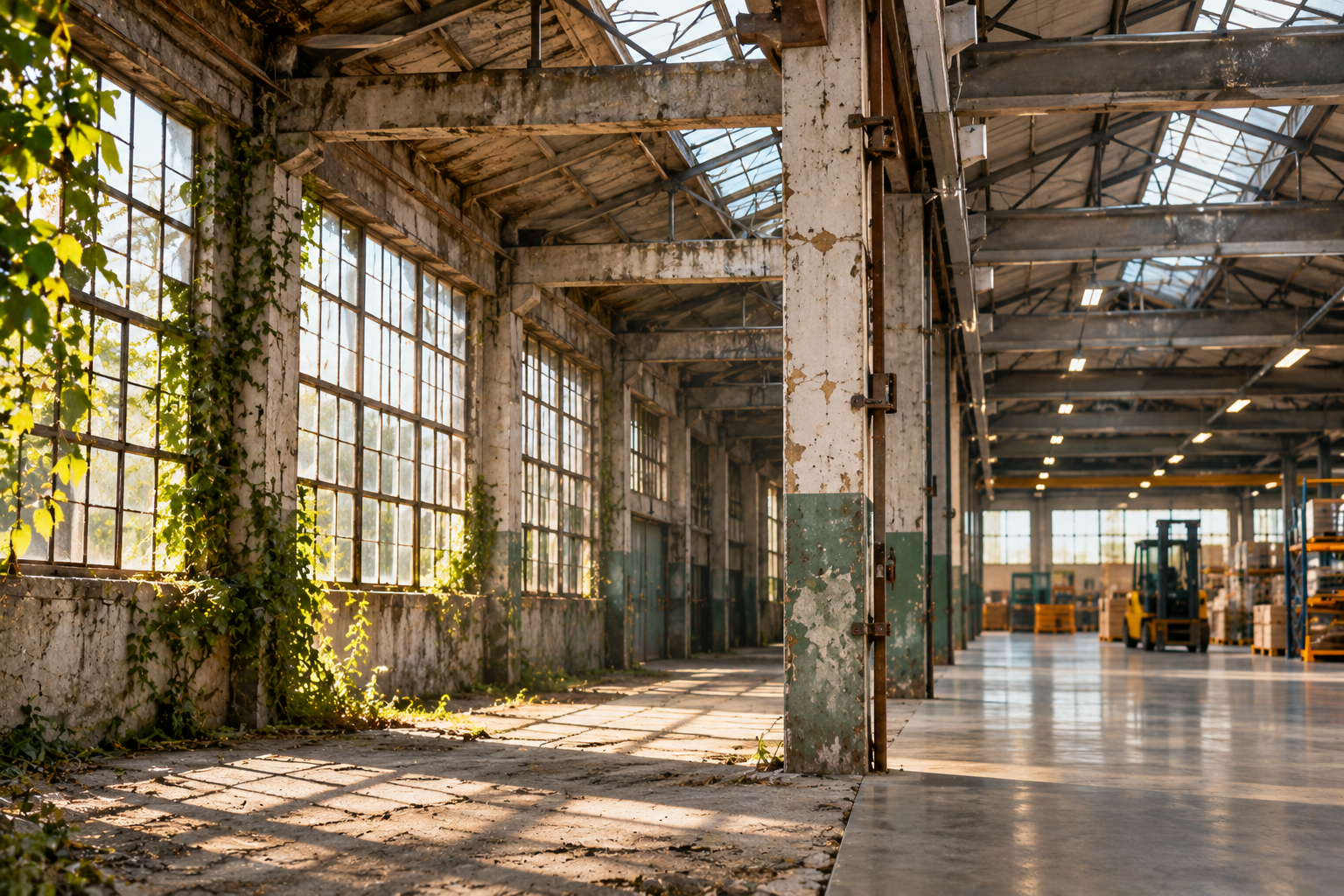
One of the most important questions when evaluating an older industrial property is what to do with the existing buildings.
Renovation may be the obvious choice when the structure is sound and the layout can accommodate modern operations.
A former production hall could potentially be adapted for warehousing, light manufacturing, assembly or other industrial uses.
In other cases, conversion may require substantial investment in insulation, flooring, electrical systems, ventilation, fire safety or loading facilities.
And sometimes, demolition and redevelopment may be the more practical solution.
Each option comes with different costs, risks and permitting requirements.
Investors should be particularly cautious about assuming that an inexpensive industrial building can be renovated cheaply.
Structural assessments, technical inspections and realistic cost estimates are essential before making that decision.
An old factory offered at an attractive price is only a bargain if the total investment required makes commercial sense.
Brownfield Sites: Opportunity Comes With Responsibility
Former industrial land, often referred to as brownfield land, can offer interesting redevelopment opportunities.
Such sites may benefit from established infrastructure and proximity to existing settlements, suppliers and workforce pools.
They may also allow investors to reuse land that has already been developed rather than expanding industrial activity onto agricultural or previously undeveloped areas.
This can be a meaningful advantage from both a planning and land-use perspective.
But brownfield redevelopment also brings specific challenges.
Previous industrial activities may have affected soil or groundwater quality. Underground structures, abandoned installations or hazardous materials may complicate redevelopment.
Ownership histories, environmental obligations and existing legal restrictions must also be examined carefully.
Environmental assessments and appropriate technical due diligence are therefore particularly important.
A brownfield site should not be considered attractive simply because it is available or inexpensive.
Its potential depends on whether the costs and responsibilities associated with redevelopment can be properly understood and managed.
Transylvania's Industrial Heritage Has a Second Life
Transylvania has a long history of manufacturing and industrial activity.
From engineering and metalworking to textiles, food processing and other production sectors, industrial development has shaped numerous towns across the region.
Some former industrial facilities are located in places that still offer relevant advantages today.
They may be close to established communities, experienced workers, transport connections or suppliers operating in related industries.
Smaller towns in Alba, Sibiu, Mureș, Hunedoara and other Transylvanian counties can contain industrial assets that receive less attention than properties in major logistics and manufacturing centres.
This does not mean every former factory is a promising investment.
Some locations have lost important economic advantages, while others face serious infrastructure or workforce limitations.
But it does mean that investment opportunities should not automatically be restricted to newly developed industrial parks or the most visible locations.
An established industrial site in a smaller town may sometimes offer a practical starting point for a business with the right operational requirements.
The Right Buyer Can Change the Value of a Property
Industrial real estate is particularly interesting because different businesses can see entirely different possibilities in the same building.
A logistics operator may reject a property because the ceiling height is insufficient for modern racking systems.
A small manufacturing company, however, may find the same building perfectly suitable for its production equipment.
A large industrial investor may consider a site too small, while a local business looking to expand may see an ideal opportunity.
A property that fails to meet the requirements of one type of occupier is not necessarily unsuitable for everyone.
This is why understanding potential users is so important.
The value of an industrial property depends not only on its physical characteristics, but also on how those characteristics match the needs of a particular business.
Sometimes, an overlooked property is simply waiting for a different type of buyer.
When Is an Overlooked Property Worth Considering?
The most promising opportunities usually combine several favourable conditions.
The location still serves a relevant business purpose. Access and utilities are available or can be upgraded at reasonable cost. The buildings can be adapted, or the land can be redeveloped, without disproportionate expense.
Equally important, the legal and environmental situation must be sufficiently clear to allow a realistic development plan.
Investors should compare the total cost of acquisition, renovation, remediation and adaptation with the cost of purchasing or developing a more conventional alternative.
Time also matters.
A redevelopment project that appears financially attractive may lose some of its advantage if permitting, construction or environmental procedures delay occupancy significantly.
The objective is not to find the cheapest neglected building.
It is to identify a property whose potential justifies the effort and investment required to unlock it.
Looking Beyond First Impressions
Industrial real estate is often evaluated through practical measurements: square metres, ceiling heights, access roads, utilities and price.
These fundamentals are essential, but they do not always tell the entire story.
An ageing factory may occupy a strategically useful location. An abandoned production site may offer infrastructure that would be costly to recreate. A neglected warehouse may be suitable for a business whose requirements differ from those of the wider market.
Of course, some properties remain vacant for very good reasons.
The skill lies in understanding the difference between an asset with genuine redevelopment potential and one whose limitations outweigh its advantages.
At Busy Brokers, we believe that good industrial real estate decisions begin with looking beyond appearances and understanding how a property can serve a business.
Because not every valuable opportunity comes in a modern building.
And sometimes, the industrial property nobody wants today is simply the one whose next purpose hasn't been discovered yet.
Busy Brokers — Connecting businesses with opportunities in Transylvania.